


YES! This is an invitation!
What: Manual Medicine Workshop
What the f.... is that?: How to turn of pain & fix body glitches with your hands.
When: Feb 21, 2010 10 am to 3 pm, with some leeway for the string of questions that kick in after we know enough to ask better and better questions.
Where: Pasig City, Philippines. AICA at Captain Henry Javier Avenue, Skyway Twin Tower 2. Next to Valle Verde Country Club. Near Bagaberde.
Why: Evolution is Calling. We like people. Sharing is good.
Also: We'd rather demo than debate.
Remember to RSVP!: Dionne is at (+63) 905 426 9496.
"There are no problems we cannot solve together,
And very few that we can solve ourselves."
(Lyndon Johnson, Former US President)
"I am sorry."
(Philippine political figure)
This is a call to our Colleagues, almost a plea.
I heard a German Quote last year which translates roughly to:
"How you shout into the forest
Determines the echo you get."
So we shout: Help us evolve this healing field.
I think it was the hockey sensation Wayne Gretzky that said:
"Invariably, The Goals I never make are those I never take."
Why not Do in minutes what others do in sessions or follow-up days?!
Session I-b (February 21, 2010)
Rapid-Reflexive De-afferentation Techniques
(R.D.T.) Foundation Techniques Dissected
The Head, Neck, and Jaw in Focus
The Point:
We would suggest as a personal Goal for everyone (on top of their own goals) after proper completion of this session:
Be able to Treat headaches in minutes (sometimes in seconds!)
Evolving Outline:
Notions / Theories:
1. How to use Bayliss Collapse / Engagement to determine local versus distal / compounded bony locks.
2. How cervical locks differ from other subluxations.
3. The Therapeutic pulse and how to use it.
4. Tracing vectors as a way of noticing Neuromyofascial Full-Body Unwinding.
5. Descriptions of the Cranial Mechanism (Interactive, Participant-based Sub-session)
6. Introduction to "Brain and Beyond" Techniques.
7. Neurologic Integration:
How to fit in Neural Sliders
How to use Reflexes as a treatment tool (Introduction to the Reflexive De-afferentation Technique Paradigm)
8. Protocols and how to dissect and modify them: (the Inglorious Basterds Paradigm)
9. RDT checkpoints
10. Parasympathetic Reboots
11. The Still Point and Beyond
Individual Techniques:
1. Cervical Rotation taken into flexion-extension cycles; active nodding; side-bending. Compare with pre-harmonic patterns.
2. Spaceman / Floatation Unwind, Supine. Can you imagine what it would be like to let your patient's body guide you into its own healing mode?
3. Mandible Disconnection from Cervical Back-bending. Biomechanics meets Proprioception.
4. The Non-surgical Facelift
5. Upper Masseter Intra-oral
6. Maxillary Lift
7. Epicranial Aponeurosis Release (CI: lateral Sphenoid Wing Compression)
8. Cranial Vector Releases:
AP
L,R
Fronto-Occipital
Diagonals L>R, R>L
Occipital L-R
9. Cranial-sacral dural release posterior hookup
10. Posterior cervical wedging, advanced, RRDT modifications
11. Cervical FB-BB in rotation, supine; Facet opener variations and LVLA openers
12. Cervical side-bending in rotation, supine
13. Multistack unwind (ever seen Eight Degrees of Freedom?), focal, vector-locking openers
14. Digastric release
15. Masseter release, local, direct, external-internal
16. Palatal arch-basing
17. Maxillary anterior lift
18. Galea aponeurosis & aponeurotic releases
19. Disconnecting jawdrop from cervical backward-bending
20. Laryngeal anterior release
NOTE that Content of proposed Session I-b above may change at any time, without prior notice, and may be modified by how many participants are present, and how much good coffee we've had.
Yes, that's a hint! Bring coffee. Bring food. (We’re at the A.I.C.A. this time)
Bring more coffee.
Cost-sharing for this Practice Upgrade Investment:
For those who register / commit to participate during the
February 21, 2010 Seminar-Workshop
Manual Medicine: Going Beyond Cervical Treatments
An Introduction to Scope, Synthesis
And Clinical Bases of Reflexive De-afferentation Techniques
(An Overview of Manual Medicine Techniques)
The following cutoff dates and corresponding fees apply:
Date of registration: cost share:
Up to December 29, 2009: P500
Up to January 31, 2009: P555
Up to February 07, 2010: P777
Up to February 14, 2010: P888
February 15 onward: P1,200
On-site: P1,555
And if you think we should really charge what we think this material is worth, please bring a few hundred dollars so we can get really good food for the workshop!
Regret that free slots are already taken.
Here’s the deal, though:
If you bring in 4 new registrants, we’ll count you in for the incredibly low price of ABSOLUTELY FREE!
Yes, we are essentially rewarding (1) early commitment and (2) a sharing of this evolving technology.
Many already understand that this is valuable information we're sharing. The techniques themselves are, in practice, invaluable.
Still, some people do not value what comes free. Yes, we know you're not like that. You know what we mean. So they are also most welcome to register late. And anyone who registered early is still most welcome to bring enough pizza for a baranggay. Or coffee. Or both. My cat likes Whiskas Ocean Fish Flavor. Yes, she asked me to tell you that. The rest of this post is very serious.
You now know how to use the Therapeutic Pulse.
Next up: How do you maximize that gift?
Ideal Audience:
Practicing Manual Therapists,
Doctors progressing into Soft Tissue and Neural Work.
GUARANTEED RESULTS!
Simple, straight, no-B.S. 100% Refund Money-back Guarantee:
Take the techniques you get from this into the clinics, into your patient's homes.
If you don't make up your money in professional fees from using at least one of the techniques here, we'll refund your money.
Experiment. Try it for eighty days. Use it! Prove us wrong! If, in that time, you have not recovered your costs because the techniques have not worked (one possible reason: whatever you DO NOT TRY does NOT WORK. Laziness voids offer.)
Next, if you have ANY technology that works better, faster for any of the indications we overlap technologies with, we'll refund your money, and pay you to show us what you have!
P.S.:
If this Challenge feels rude,
Who is it that's reacting?
If you have any resistance to this,
Why is that?
Ever notice how peak moments and life-changing events can be scary right before you get a grip on them?
WHERE IS EVERYONE'S REGISTRATION DATA?
To confirm registration, please leave a note with your nearest coordinator, to be forwarded to Dionne with your coordinator's endorsement, with the following data:
1. Your name, designation, institution, position occupied or maintained
2. A brief statement declaring why you're attending
3. The names of your two study-buddies
4. A brief list of what you already know, what you're certified to practice, and what you have mastery of.
WE RESERVE THE RIGHT TO TURN AWAY ANYONE WHO DOES NOT COMPLY WITH THIS REQUEST. This also lets us free us your seat to others who are raring to join us. Did we mention we overbooked early?
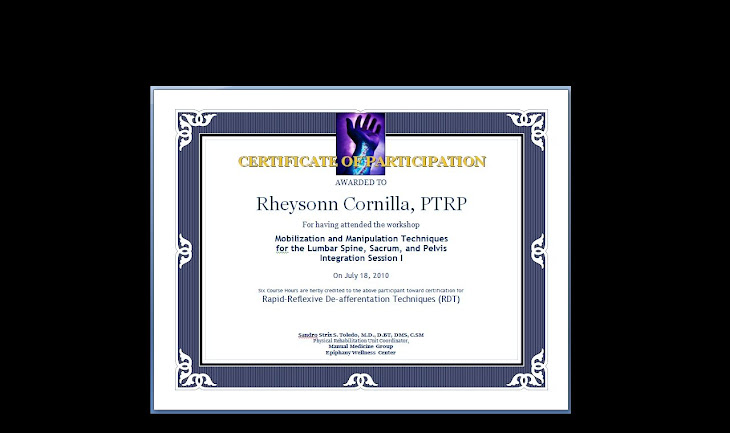
P.S., we truly are sorry. While certificates will be issued, if you are merely looking for a piece of paper to stuff your portfolio or crowd your wall with, please offer your slot to any colleague you believe will more benefit from this. Your understanding with regard this matter is much appreciated.
ATTIRE:
Please come in either loose, comfortable clothing (anything easily removable is preferred) or in thin, body hugging clothing (no neoprene dive suits or Gortex body armor).
EQUIPMENT:
Please bring a large towel. One neuro hammer per group would be useful. One goniometer per group would be great. Those who prefer to bring along an anatomy atlas will be most welcome to do so. One skin marker or eyeliner pen per group may prove useful. One small, thin, long towel (Barbero towel) would be useful as well. A skin marker or eyeliner per group would be very useful for newbies.
SUGGESTED WORKSHOP FORMAT:
Preferably, three people will be assigned per group / table / plinth. They will alternate roles: patient, practitioner, and preceptor. This enables each participant to see each technique twice in their own time. Corrections and adaptations may be incorporated during each second demo.
Group numbers will be assigned. Each group will rotate a member at the main demo table at the front of the class at the start of each new technique demo. That group's two other members come closest to the main table to observe and ask questions re each new technique. This enables each group of three to become the resource persons for at least one technique. They can then proceed to master that technique and pass it on. They are thus encouraged to learn each technique they are decked to a degree worthy of peer review and learning. One or more groups may thus, over time, pass their mastered technique onto others. This will also engender a collaboration between colleagues (and perhaps between institutions), who may choose to meet to master each other's sets in between workshops. They are encouraged to pass on well-mastered techniques to uninitiated colleagues.
As in life, these are mere suggestions. (They do, however, make the ride much more worthwhile.)
(Per request, this is now starting to look like a manual! That's a hint, colleagues! Anyone want to volunteer to have their name printed as a co-author on a manual?)
One of the best ways we know of
to get out of a rut
is amazingly simple:
ASK GOOD QUESTIONS.
So,
here's a little attempt at that.
Have you ever walked away from a workshop remembering nothing?
Have you ever walked away from a workshop with a bunch of techniques and no idea how they all fit?
Are you regularly using techniques from the last few workshops you've been to?
Have you ever wanted to design your own workshop?
If you could do things better, what would you do?
It's happened to us, so we're asking.
And now we're asking you.
Help us do this better.
Help us so this works for you.
Paraphrased from the Late Pope John Paul II:
"This is one way,
not necessarily
THE way."
WHAT IS YOUR WAY, and where does it lead?
May you be blessed abundantly in every way.
See you at the Sessions.
Yours in the Evolution of Manual Medicine,
Wednesday, February 3, 2010


Sunday, January 31, 2010
Why use Manual Medicine / Manual Therapy?
This is an unedited letter from Harold, who has gone on to progress his practice in the USA:
Hi…good day Dr. Strix, Seniors and most importantly my fellow manual therapist. I may not be in the Philippines and with The Manual Medicine Group still I continue to support the group and its advocacies for one main reason and that is to bring all your thinking out of the box…he he he! Well I don’t know how to start but I would say that the first time I worked here in US the first two words came in my mind is WTF and Amazing. Let me say this before I start anything.
My Intent:
1. To tell you guys that your in the right place and time
2. That your not wasting anything
3. All things that you’re going to learn from that MMG will not be just bound or usefull in the Philippines but also here in the USA
3. That before starting to learn something new clear your intent that you guys come to this workship because of the skill that will make your patient better and not because of the certificates and extension that you’ll be waving in your FS and FB
Hmmm..my discoveries started when I got my orientation in the facility when the rehab coordinator told us that things here in America are a lot different and that experience will count but will not weigh..hmmm…on my thought I felt sad because after years of experience seeking new skills so that I can be competitive here are gone or is just a waste of time and effort but things got a little different when they assigned in an outpatient clinic where I met Dr. Turovets, Dr Randall who are by the Chiropractors and Efren who is a massage therapist. I saw How they treat patients which gave a burning desire to go on head to head with what they’re doing because I saw them checking leg length, spine alignment and doing soft tissue…to my senses hey I could do that better..the way Doc strix bastardize all the manual techs..so I begun to see my patient. To my amaze before I start the patient it is usually the massage therapist who does the soft tissue mobilization (mind you guys they’re damn good!!!) then I asked efren whats next,,,he answered me to correct them or adjust…so I did what I do best manipulate…he he he! After two days I was surprised that when the secretary at the reception talked to that most of the patient where requesting me to treat them…I said ok but the OK was not ok because they were 60 patient lining up for me that I was not aware of WTF…. After a week of work the two chiropractors talked to me because they were intrigue of what I’m doing, I told them that I was doing DORN, NDS, METS, RDTS, MFR, EASE etc but general its just a manual therapy…then they begun discussing their system….from there we begun to synthesize our skills that they are willing to teach some of theirs. On PICTURE 1 – they call this the adjuster in which instead of using your hand doing HVLA we just position the segment and point this one. TOOL 1 I don’t know what they call this but its very helpful in mobilizing the facets instead using your thumb. THAMPER AND THAMPER 1 the very same tool that we are using in treating patient when doing home visit, Dr strix has this one. ME thats my picture going to work (mag-isa lang kaya solo shot..he he he!).WORKPLACE that the loby of my clinic..he he he!that’s my ride he he he!(joke lang)
Bottom line is that with the skills that I acquired from MMG helped me a lot that in adjusting to my work (that is of course if your going to work in an OPD and musculoskeletal not in sub-acute or nursing home). Certification are good but even your not certified but if you know what you doing it is good rather than being certified but does not know of what your doing(SOME PEOPLE ARE LIKE THAT)..ewww…that’s nasty!!!!...Currently I’m learning their system of spine adjustment (that’s what they like to call it not manipulation). Basically as of know the basis of their treatment is not on the leg length and pelvis but more of neck. Hopefully I can share this with you guys but of course through MMG and through the graces of Dr. Strix. I hope that even I’m not their, all of you guys will continue to practice and evolve our skills together and not be satisfied of what we know but rather see thing a an infinite set of skills that needed to learned, discovered and utilized for the benefits our patient.
Hi…good day Dr. Strix, Seniors and most importantly my fellow manual therapist. I may not be in the Philippines and with The Manual Medicine Group still I continue to support the group and its advocacies for one main reason and that is to bring all your thinking out of the box…he he he! Well I don’t know how to start but I would say that the first time I worked here in US the first two words came in my mind is WTF and Amazing. Let me say this before I start anything.
My Intent:
1. To tell you guys that your in the right place and time
2. That your not wasting anything
3. All things that you’re going to learn from that MMG will not be just bound or usefull in the Philippines but also here in the USA
3. That before starting to learn something new clear your intent that you guys come to this workship because of the skill that will make your patient better and not because of the certificates and extension that you’ll be waving in your FS and FB
Hmmm..my discoveries started when I got my orientation in the facility when the rehab coordinator told us that things here in America are a lot different and that experience will count but will not weigh..hmmm…on my thought I felt sad because after years of experience seeking new skills so that I can be competitive here are gone or is just a waste of time and effort but things got a little different when they assigned in an outpatient clinic where I met Dr. Turovets, Dr Randall who are by the Chiropractors and Efren who is a massage therapist. I saw How they treat patients which gave a burning desire to go on head to head with what they’re doing because I saw them checking leg length, spine alignment and doing soft tissue…to my senses hey I could do that better..the way Doc strix bastardize all the manual techs..so I begun to see my patient. To my amaze before I start the patient it is usually the massage therapist who does the soft tissue mobilization (mind you guys they’re damn good!!!) then I asked efren whats next,,,he answered me to correct them or adjust…so I did what I do best manipulate…he he he! After two days I was surprised that when the secretary at the reception talked to that most of the patient where requesting me to treat them…I said ok but the OK was not ok because they were 60 patient lining up for me that I was not aware of WTF…. After a week of work the two chiropractors talked to me because they were intrigue of what I’m doing, I told them that I was doing DORN, NDS, METS, RDTS, MFR, EASE etc but general its just a manual therapy…then they begun discussing their system….from there we begun to synthesize our skills that they are willing to teach some of theirs. On PICTURE 1 – they call this the adjuster in which instead of using your hand doing HVLA we just position the segment and point this one. TOOL 1 I don’t know what they call this but its very helpful in mobilizing the facets instead using your thumb. THAMPER AND THAMPER 1 the very same tool that we are using in treating patient when doing home visit, Dr strix has this one. ME thats my picture going to work (mag-isa lang kaya solo shot..he he he!).WORKPLACE that the loby of my clinic..he he he!that’s my ride he he he!(joke lang)
Bottom line is that with the skills that I acquired from MMG helped me a lot that in adjusting to my work (that is of course if your going to work in an OPD and musculoskeletal not in sub-acute or nursing home). Certification are good but even your not certified but if you know what you doing it is good rather than being certified but does not know of what your doing(SOME PEOPLE ARE LIKE THAT)..ewww…that’s nasty!!!!...Currently I’m learning their system of spine adjustment (that’s what they like to call it not manipulation). Basically as of know the basis of their treatment is not on the leg length and pelvis but more of neck. Hopefully I can share this with you guys but of course through MMG and through the graces of Dr. Strix. I hope that even I’m not their, all of you guys will continue to practice and evolve our skills together and not be satisfied of what we know but rather see thing a an infinite set of skills that needed to learned, discovered and utilized for the benefits our patient.
Saturday, January 30, 2010
What do you need to learn?
We'll very often act from what we believe. What happens when what we've believed all along turns out to be wrong, outdated, or just simply outclassed?
There's enough research to show us that the universe is continually expanding. Are you growing along with it? (No, the tummy doesn't count.)
Perhaps because we were built so well, this need to progress wells up inside us. It looks like it's almost a law. Is it?
"Go, grow, evolve."
"Create or Disintegrate."
Think about it.
This is an open invitation to learn various aspects of manual medicine with us.
Let us know what you want to learn, what you need to learn, what would be useful for you to learn, what would be profitable for you to learn.
Whether it be aspects related to functional gains, biomechanics, soft tissue releases, connective tissue mobilization, nerve mobilizations, visceral manipulation, sports medicine, cranial techniques, beyond cranial techniques, and mind-body techniques, there's gotta be something you've always wanted to learn in order to progress your craft.
This is an invitation to bring those questions with you.
Better questions means more distinctions, better answers.
Imagine what great solutions we can come up with when we have a community trained to ask better and better questions.
Imagine how well your skills would refine themselves.
Imagine being sought out in your area, in your field
for what we deem is the best bottomline:
What's good for your patients?
How can we help?
And yes, we meet up for the next sharing session on February 21, 2010.
Bring questions. And food. Lots of both.
God Bless you always.
There's enough research to show us that the universe is continually expanding. Are you growing along with it? (No, the tummy doesn't count.)
Perhaps because we were built so well, this need to progress wells up inside us. It looks like it's almost a law. Is it?
"Go, grow, evolve."
"Create or Disintegrate."
Think about it.
This is an open invitation to learn various aspects of manual medicine with us.
Let us know what you want to learn, what you need to learn, what would be useful for you to learn, what would be profitable for you to learn.
Whether it be aspects related to functional gains, biomechanics, soft tissue releases, connective tissue mobilization, nerve mobilizations, visceral manipulation, sports medicine, cranial techniques, beyond cranial techniques, and mind-body techniques, there's gotta be something you've always wanted to learn in order to progress your craft.
This is an invitation to bring those questions with you.
Better questions means more distinctions, better answers.
Imagine what great solutions we can come up with when we have a community trained to ask better and better questions.
Imagine how well your skills would refine themselves.
Imagine being sought out in your area, in your field
for what we deem is the best bottomline:
What's good for your patients?
How can we help?
And yes, we meet up for the next sharing session on February 21, 2010.
Bring questions. And food. Lots of both.
God Bless you always.
Subscribe to:
Posts (Atom)


 Posts
Posts

