


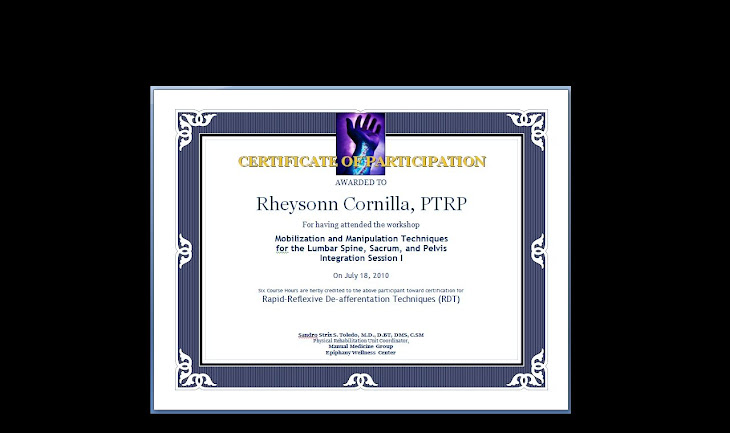
Thank you for coming!
See you on February 21 2010,
When we refine your skills and "Go beyond" Cervical treatments.
Completed Workshop / Seminar / Sharing Session:
Manual Medicine: An Introduction to Scope, Synthesis
and Clinical Bases of Rapid Reflexive De-afferentation Techniques
(An Overview of Manual Medicine Techniques)
January 24, 2010
Time: 10 a.m. to 4 p.m. (ask Rheysonn how long that actually is)
Call time and late registration: 9 am.
Venue: DLSU Dasmarinas Cavite (with many thanks to the faculty offer to host this session)
Contact: DIONNE at +639054269496
Content: A view of the forest, with a fair look at the trees. For the inquisitive, you may actually see the leaves, too.
Or, for the suddenly enlightened, the ecosystem might begin to make sense.
Course Hours: Six.
Pre-requisites:
Anatomy and Physiology Courses and continued Familiarity
License to Practice
Vertebral Artery Screening
Vestibular Screening
Maintained blood pressure
Open Mind [While most material presented will be mainstream, new technology will always look like magic do anyone who's never seen it.]
(For everyone else, you won't get left out! No judgments here. We all have something which can benefit our fellow living beings. It's all cool. Everyone is exactly where they have to be at the moment. In fact, Friends of mine are starting support groups:
(1) Critics for the Sake of Criticism
(2) Debate Club - also open to pre-teens onwards
(3) Understanding Evidence-Based Clinical Practice
Session I-a:
Technique Set: Neuromyofascial
System Focus: Head and Neck
Additional Techniques, Introduction: Articulatory, Thrust, RRDTs.
Techniques / Coverage / Flow:
intro / backgrounder
intent / vision / goals
Why NMFR / NiMFA ?
the path of ease
the importance of breath
the therapeutic pulse
Session Proper:
Evaluative Phase:
1. Postural Cues (landmarks, bearing, loading; seated / standing)
2. Zink Assessment for Junctional Freedoms (what is physiologic / compensated / uncompensated?)
Degrees of freedom demonstrated for the H&N (how many degrees of freedom are there?)
3. NOD testing for AO (how freely is the cranium suspended?)
4. VOR - Vestibular-Orienting Release (allow for gravity drop) (also proprioceptive)
Neuromyofascial Realeases:
(1.) Cat grabs for upper traps (traps drain / MFR)
(2.) Neck-Shoulder Differential Release, Superficial, in neck rotation and FB
(bind outer layers at restrictions, mobilize inner layers, shoulders, chest) (compare to Lederman's Cervical Harmonics) (broad versus specific releases)
(3.) Platysma (rotation bind at superficial pectoral fascia + active facial recruitment)
upper rib releases
(4.) SCM attachment release
active head movement; minimize SCM movement
(5.) anterior scalene release
supine; broad contact at scalenius anterior
posterior palpatory feedback: cervical segment tabledrop
indications: thoracic outlet syndrome, Anterior Neck Syndrome
(6.)Sleeve-Core Differentiation in Cervical Rotation:
Sleeve Bind, Core Roll
(a.)Bind with back of phalanges "Mano Po"
(b.)Overweight Turtle: Occipital hold against Neck-bind Caudal Drift
"Help that head out."
(7.)The 69 (Ulnar Traction Bind, Active Creep) (Cervical Rotation, FB, BB)
prone head-drape over plinth edge; Broad ulnar contact
(8.)Sidelain rotation releases
(a.) Downfist hold at neck; ceiling roll
(b.) Open Backhand hold at shoulder; ceiling roll
NMFAR = ARTICULATORY-NEUROMYOFASCIAL TECHNIQUES:
(1.) First RIB positional release, PA gravity-drop (slow Articular)
*** If time permits, we'll have a very superficial description of alternative 1st rib manipulations, when they may be useful, and why we usually DO NOT use them (other Doctor's techniques).
(2.) Cervical Stack Release:
"Casino Chips"
(3.) Cervical Circumduction with C7-T1 Lock
Pistol-cup handhold
(4.) CT Hold Augmented Side-bending:
feel extension of technique into neck and torso
knee-hand fulcrum hold
(5.) cervical vertebra translation|side-bending
note inverse relation of translation and SB
JUNCTIONAL Articulatory TECHNIQUES:
Cervico-thoracic Techniques:
(1.) Articulatory-thrust / Flexion-Distraction
(Low-velocity Low Amplitude) (LVLA/MVLA-Art)
FB-distraction Articulatory thoracic Anterior Techniques:
(C7 upon T1; T1-T3)
(2.)Cervico-thoracic Junctional collar release
cylindrical rotatory handle (Crankshaft)
Atlanto-Occipital Techniques:
(1.)Cervical Vertebral Mobility, Prone
Check rotation
Stabilizer / Contact hand versus Mobilizer hand
(2.)Dial Release for Atlanto-Axial C1-C2
45 degree forward-bending lock
local atlas-transverse process release
notion of TP posteriority with rotation SD
direct transverse process derotation
one-handed versus two-handed techniques
indirect technique, positional release (PRT)
(3.)AO lift glide: "Deep throat"
anterior translation - backward-bending
posterior translation - forward-bending
Hand-hold variations: Vertex-AO versus Two-handed collar
(4.)AO Wedge Release
AO freedom
Inhibition notion
Description of RRDT variation
AO-dural release: occipital traction through Dura, Posterior longitudinal ligament..
N.L.P. language / semantics
(5.)Towel and T-band releases:
infra-occipital hook
traction in backward-bending
"curved-angular" traction for brachial plexus, nerve sheath releases, levator scapulae
pre-harmonic swing-rock
rotational rolls - gentle
thoracic hold swing rock harmonic
dural cord
proprioceptive conditioning techniques:
(1.)ghost on the shell
(2.)Xiphoid-Halux Hookup:
middle finger, left hand
big toes, both feet, right hand
kinesthetic-proprioceptive connection
(3.)Head floater
Comparison to Dorn Method floater
N.L.P language re frontal headfall into palm, occipital cradling
NM Re-education
Nuchal Releases:
(1) Longitudinal
lengthening
occipital FB traction
spidermouth mounting hold, static
(2) Horizontal uncrowding
Nonlocal Integration / Completion:
(1.) antero-lateral sacral wedging
medial to PSIS
(2.) Dural-sacral release, prone
With Gratitude,
Yours in the Evolution of Manual Medicine,
Sunday, January 3, 2010


Thursday, December 31, 2009
TENS is NOT recommended for treatment of low back pain
Why are we not at all surprised?
If you've been using TENS for ages, noting how poorly it works for anything other than transient pain gating for neurologic pain, here's another shot againt that practice that you may want to review.
From Medscape Medical News
AAN Guideline Recommends Against TENS for Chronic Low-Back Pain
Susan Jeffrey
December 31, 2009 — A new evidence-based review from the American Academy of Neurology concludes that transcutaneous electric nerve stimulation (TENS) is not recommended for use in treating chronic low-back pain but adds that TENS should be considered to treat diabetic neuropathy.
The report, from the academy's Therapeutics and Technology Assessment Subcommittee, was published online December 30 in Neurology. Authors on the new document are Richard M. Dubinsky, MD, MPH, from Kansas University Medical Center in Kansas City, and Janis Miyasaki, MD, MEd, from Toronto Western Hospital, Ontario, Canada.
"In the highest-quality studies of chronic low back pain, there was no benefit of TENS compared to sham or placebo TENS, leaving us to conclude that it is of no benefit, and make a recommendation that it should not be used for chronic low back pain," Dr. Dubinsky told Medscape Neurology.
In diabetic polyneuropathy, some studies showed slight benefit, he added. "We concluded it should be considered in the treatment of diabetic polyneuropathy."
Systematic Review
TENS has been used to treat neurologic and other disorders for decades, the authors write. The biologic basis of its analgesic effect is not known, but it is used is based on the gate theory of pain, they note. In this assessment, the authors carried out a systematic literature search of Medline and Cochrane Library up to April 2009, looking for controlled clinical trials in which TENS was used to treat pain associated with neurological conditions.
Acute low back pain not normally seen in neurologic conditions was not considered in this review. All but 1 of the studies excluded patients with known causes of low-back pain, such as pinched nerves, severe scoliosis, severe spondylolisthesis, or obesity.
"We only found 2 conditions that had adequate rigor in the research, and that was chronic back pain and diabetic polyneuropathy," Dr. Dubinsky said.
The studies included showed conflicting results in chronic low back pain. Two class 2 studies showed benefit, but 2 class 1 studies and another class 2 study showed no benefit. "Because the Class I studies are stronger evidence, TENS is established as ineffective for the treatment of chronic low back pain," they write.
Two class 2 studies suggested that TENS is probably effective in treating painful diabetic neuropathy. The only specific neurologic cause of chronic low-back pain in which TENS was studied was multiple sclerosis, for which TENS was not shown to be of benefit.
The document makes 2 main recommendations:
TENS is not recommended for the treatment of chronic low-back pain because of a lack of proven efficacy (level A, 2 class 1 studies).
TENS should be considered for the treatment of painful diabetic neuropathy (level B, 2 class 2 studies).
The document also gives some guidance on the need for further research into TENS, Dr. Dubinsky noted. Among their recommendations were determining what the best paradigm is, in terms of current, pulse-width, and frequency, and then using it in patients who are naive to TENS so that they will be truly blinded to treatment allocation, and studying TENS in patients with well-defined neurological conditions.
Absence of Evidence
In an editorial accompanying the new document, Andreas Binder, MD, and Ralf Baron, MD, from the Division of Neurological Pain Research and Therapy in the Department of Neurology at Christian-Albrechts-Universität Kiel, Germany, write that the conclusions of Dr. Dubinsky and Dr. Miyasaki "may heat up the discussion on the usability of TENS and may be viewed as supporting the critics who questioned the value of TENS in pain therapy.
"However," they add, "absence of evidence is not evidence of absence. The clinical impact of meta-analyses is always limited by the quantity and quality of conducted trials."
TENS has had a long-standing role in pain management, is easy to handle, has a favorable benefit-to-risk ratio, and can be discontinued easily if it is not efficacious — all "desirable properties when treating pain," they write. The new document calls for further trials and even provides "clearcut recommendations for their conduction," they note.
"This updated evidence-based review is valuable in providing the limits of our evidence base," Dr. Binder and Dr. Baron conclude. "Nevertheless, it is not unreasonable to take a practical position that, in spite of the relatively weak scientific and clinical evidence, TENS still represents a valuable therapeutic alternative in neurologic pain disorders.
"Taking the favorable benefit-risk ratio when compared with other pain relieving methods into account, TENS remains a valuable part in the armamentarium of pain therapy."
Dr. Dubinsky serves on a scientific advisory board and speakers' bureau for Allergan Inc, receives honoraria from BrioMed, and receives research support from Allergan Inc, Merz Pharmaceuticals GmbH, and the National Institutes of Health, the NIAM/National Institute of Neurological Disorders and Stroke, and the National Center for Complementary and Alternative Medicine, and his spouse owns stock in Abbott. Disclosures for coauthors appear in the paper. Dr. Binder has received travel expenses for lectures and educational activities not funded by industry and has received honoraria for speaking engagements and educational activities from Grünenthal, Allergan Inc, and Pfizer Inc. Dr. Baron serves on scientific advisory boards, as a consultant, and on speakers' bureau for Pfizer Inc, Genzyme Corporation, Grünenthal, Mundipharma International, Allergan Inc, Sanofi Pasteur, Medtronic Inc, Eisai Inc, UCB, Eli Lilly and Company, and Astellas Pharma Inc; has received travel expenses for lectures or educational activities not funded by industry; serves as an associate editor of Pain and on the editorial advisory boards of Nature Reviews Neurology and the European Journal of Pain; and has received research support from Pfizer Inc, Genzyme Corporation, Grünenthal, the German Ministry of Research, and DFG, Deutsche Forschungsgemeinschaft.
Neurology. Published online December 30, 2009.
Authors and Disclosures
Journalist
Susan Jeffrey
Susan Jeffrey is the news editor for Medscape Neurology & Neurosurgery. Susan has been writing principally for physician audiences for nearly 20 years. Most recently, she was news editor for thekidney.org and also wrote for theheart.org; both of these Web sites have been acquired by WebMD. Prior to that, she spent 10 years covering neurology topics for a Canadian newspaper for physicians. She can be contacted at SJeffrey@webmd.net.
Medscape Medical News © 2009 Medscape, LLC
Send press releases and comments to news@medscape.net.
If you've been using TENS for ages, noting how poorly it works for anything other than transient pain gating for neurologic pain, here's another shot againt that practice that you may want to review.
From Medscape Medical News
AAN Guideline Recommends Against TENS for Chronic Low-Back Pain
Susan Jeffrey
December 31, 2009 — A new evidence-based review from the American Academy of Neurology concludes that transcutaneous electric nerve stimulation (TENS) is not recommended for use in treating chronic low-back pain but adds that TENS should be considered to treat diabetic neuropathy.
The report, from the academy's Therapeutics and Technology Assessment Subcommittee, was published online December 30 in Neurology. Authors on the new document are Richard M. Dubinsky, MD, MPH, from Kansas University Medical Center in Kansas City, and Janis Miyasaki, MD, MEd, from Toronto Western Hospital, Ontario, Canada.
"In the highest-quality studies of chronic low back pain, there was no benefit of TENS compared to sham or placebo TENS, leaving us to conclude that it is of no benefit, and make a recommendation that it should not be used for chronic low back pain," Dr. Dubinsky told Medscape Neurology.
In diabetic polyneuropathy, some studies showed slight benefit, he added. "We concluded it should be considered in the treatment of diabetic polyneuropathy."
Systematic Review
TENS has been used to treat neurologic and other disorders for decades, the authors write. The biologic basis of its analgesic effect is not known, but it is used is based on the gate theory of pain, they note. In this assessment, the authors carried out a systematic literature search of Medline and Cochrane Library up to April 2009, looking for controlled clinical trials in which TENS was used to treat pain associated with neurological conditions.
Acute low back pain not normally seen in neurologic conditions was not considered in this review. All but 1 of the studies excluded patients with known causes of low-back pain, such as pinched nerves, severe scoliosis, severe spondylolisthesis, or obesity.
"We only found 2 conditions that had adequate rigor in the research, and that was chronic back pain and diabetic polyneuropathy," Dr. Dubinsky said.
The studies included showed conflicting results in chronic low back pain. Two class 2 studies showed benefit, but 2 class 1 studies and another class 2 study showed no benefit. "Because the Class I studies are stronger evidence, TENS is established as ineffective for the treatment of chronic low back pain," they write.
Two class 2 studies suggested that TENS is probably effective in treating painful diabetic neuropathy. The only specific neurologic cause of chronic low-back pain in which TENS was studied was multiple sclerosis, for which TENS was not shown to be of benefit.
The document makes 2 main recommendations:
TENS is not recommended for the treatment of chronic low-back pain because of a lack of proven efficacy (level A, 2 class 1 studies).
TENS should be considered for the treatment of painful diabetic neuropathy (level B, 2 class 2 studies).
The document also gives some guidance on the need for further research into TENS, Dr. Dubinsky noted. Among their recommendations were determining what the best paradigm is, in terms of current, pulse-width, and frequency, and then using it in patients who are naive to TENS so that they will be truly blinded to treatment allocation, and studying TENS in patients with well-defined neurological conditions.
Absence of Evidence
In an editorial accompanying the new document, Andreas Binder, MD, and Ralf Baron, MD, from the Division of Neurological Pain Research and Therapy in the Department of Neurology at Christian-Albrechts-Universität Kiel, Germany, write that the conclusions of Dr. Dubinsky and Dr. Miyasaki "may heat up the discussion on the usability of TENS and may be viewed as supporting the critics who questioned the value of TENS in pain therapy.
"However," they add, "absence of evidence is not evidence of absence. The clinical impact of meta-analyses is always limited by the quantity and quality of conducted trials."
TENS has had a long-standing role in pain management, is easy to handle, has a favorable benefit-to-risk ratio, and can be discontinued easily if it is not efficacious — all "desirable properties when treating pain," they write. The new document calls for further trials and even provides "clearcut recommendations for their conduction," they note.
"This updated evidence-based review is valuable in providing the limits of our evidence base," Dr. Binder and Dr. Baron conclude. "Nevertheless, it is not unreasonable to take a practical position that, in spite of the relatively weak scientific and clinical evidence, TENS still represents a valuable therapeutic alternative in neurologic pain disorders.
"Taking the favorable benefit-risk ratio when compared with other pain relieving methods into account, TENS remains a valuable part in the armamentarium of pain therapy."
Dr. Dubinsky serves on a scientific advisory board and speakers' bureau for Allergan Inc, receives honoraria from BrioMed, and receives research support from Allergan Inc, Merz Pharmaceuticals GmbH, and the National Institutes of Health, the NIAM/National Institute of Neurological Disorders and Stroke, and the National Center for Complementary and Alternative Medicine, and his spouse owns stock in Abbott. Disclosures for coauthors appear in the paper. Dr. Binder has received travel expenses for lectures and educational activities not funded by industry and has received honoraria for speaking engagements and educational activities from Grünenthal, Allergan Inc, and Pfizer Inc. Dr. Baron serves on scientific advisory boards, as a consultant, and on speakers' bureau for Pfizer Inc, Genzyme Corporation, Grünenthal, Mundipharma International, Allergan Inc, Sanofi Pasteur, Medtronic Inc, Eisai Inc, UCB, Eli Lilly and Company, and Astellas Pharma Inc; has received travel expenses for lectures or educational activities not funded by industry; serves as an associate editor of Pain and on the editorial advisory boards of Nature Reviews Neurology and the European Journal of Pain; and has received research support from Pfizer Inc, Genzyme Corporation, Grünenthal, the German Ministry of Research, and DFG, Deutsche Forschungsgemeinschaft.
Neurology. Published online December 30, 2009.
Authors and Disclosures
Journalist
Susan Jeffrey
Susan Jeffrey is the news editor for Medscape Neurology & Neurosurgery. Susan has been writing principally for physician audiences for nearly 20 years. Most recently, she was news editor for thekidney.org and also wrote for theheart.org; both of these Web sites have been acquired by WebMD. Prior to that, she spent 10 years covering neurology topics for a Canadian newspaper for physicians. She can be contacted at SJeffrey@webmd.net.
Medscape Medical News © 2009 Medscape, LLC
Send press releases and comments to news@medscape.net.
Wednesday, December 30, 2009
What is Reflexive Antagonism?
Reflexive Antagonism
From Wikipedia, the free encyclopedia
Reflexive Antagonism is the phenomenon by which muscles with opposing functions tend to antagonistically inhibit each other. When one muscle is activated, its opposite muscle or muscle group or is reflexively inhibited or deactivated.
Reflexive antagonism is the basic original notion behind indirect muscle energy techniques. While this notion is now understood to be incomplete, the clinical mechanism of Reflexive Antagonism continues to be useful in widespread Osteopathic and OMT-derived practice. Reciprocal Inhibition is a synonym. (See Entry under Muscle Energy Techniques)
Techiques that utilize reflexive antagonism, (such as Rapid De-Afferentation Techniques) are manual medicine techniques and protocols that utilize reflexive pathways and the phenomenon of reciprocal inhibition as a means of switching off inflammation, pain, and protective spasm for entire synergistic muscle groups or singular muscles and soft tissue structures.
While widely accepted as a clinical mechanism in Osteopathic Manipulative Medicine / Osteopathic Manipulative Techniques, Reflexive Antagonism form only part of the picture of why Muscle Energy Techniques work. Among reasons cited for further investigation into MET mechanisms the following are most significant: 1. The Reflexive Antagonism phenomenon is now known to be fleeting, incomplete, and weak. By example, when the triceps brachii is stimulated, the biceps is reflexively inhibited. The incompleteness of the effect is related to postural and functional tone. 2. Reflexes in vivo are polysynaptic, with entire muscle groups responding to noxius stimuli (Nociceptive Withdrawal Reflex). A pure Reflexive Antagonism has only been demonstrated in the lab.
From Wikipedia, the free encyclopedia
Reflexive Antagonism is the phenomenon by which muscles with opposing functions tend to antagonistically inhibit each other. When one muscle is activated, its opposite muscle or muscle group or is reflexively inhibited or deactivated.
Reflexive antagonism is the basic original notion behind indirect muscle energy techniques. While this notion is now understood to be incomplete, the clinical mechanism of Reflexive Antagonism continues to be useful in widespread Osteopathic and OMT-derived practice. Reciprocal Inhibition is a synonym. (See Entry under Muscle Energy Techniques)
Techiques that utilize reflexive antagonism, (such as Rapid De-Afferentation Techniques) are manual medicine techniques and protocols that utilize reflexive pathways and the phenomenon of reciprocal inhibition as a means of switching off inflammation, pain, and protective spasm for entire synergistic muscle groups or singular muscles and soft tissue structures.
While widely accepted as a clinical mechanism in Osteopathic Manipulative Medicine / Osteopathic Manipulative Techniques, Reflexive Antagonism form only part of the picture of why Muscle Energy Techniques work. Among reasons cited for further investigation into MET mechanisms the following are most significant: 1. The Reflexive Antagonism phenomenon is now known to be fleeting, incomplete, and weak. By example, when the triceps brachii is stimulated, the biceps is reflexively inhibited. The incompleteness of the effect is related to postural and functional tone. 2. Reflexes in vivo are polysynaptic, with entire muscle groups responding to noxius stimuli (Nociceptive Withdrawal Reflex). A pure Reflexive Antagonism has only been demonstrated in the lab.
Subscribe to:
Posts (Atom)


 Posts
Posts

